
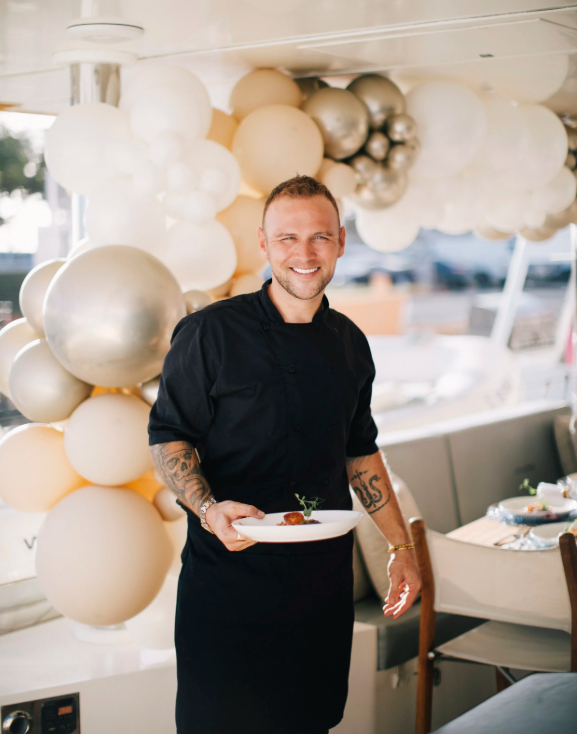
Most guests booking a private catamaran charter in Oahu focus on the boat, the sunset, the cocktails, and the guest list. What they don't yet know is that the single element with the highest capacity to elevate the entire day is the one they haven't considered: the chef.
We've covered elsewhere why adding a private chef changes the whole character of a charter, and we've published the menus and pricing separately. This article is different. This is what actually happens on a private catamaran when Chef Ethan Meyers is onboard, told the way guests experience it: moment by moment, course by course, from the first welcome pupu to the last spoonful of panna cotta at dusk.
If you're deciding whether to add the chef service to your charter, this is the article that answers the "but what does it actually look like" question that our menu-focused pieces cannot fully answer.
|
5
Courses timed to your sail
|
3 hrs
From dock to dessert
|
1
Chef, plating everything for you
|
0
Other tables sharing the view
|
Chef Ethan Meyers brings pre-prepped ingredients aboard at the start of your charter and finishes each course in the galley to timing you barely notice. What you experience is a five-course dinner served at a floating restaurant with the entire Pacific as your dining room, and a sunset that arrives, on cue, between courses three and four.
The Hour Before Boarding: What You Don't See
The chef experience starts long before you arrive at Kewalo Basin.
Roughly 90 minutes before your charter departs, Chef Ethan is at his prep kitchen, breaking down the ingredients he sourced 72 hours earlier from local farms and fisheries. Fresh scallops for the starter. Center-cut filet mignon for the main. Lobster tails for the butter-poached lobster course. Herbs, gastriques, the ube for the puree, the mint jam reduction. Everything gets pre-prepped to a specific point of readiness that will let him finish each course at sea, in a galley the size of a walk-in closet, with the boat gently moving.
By the time you're pulling into Kewalo Basin, he's arriving with sealed containers, warmed serving pieces, and a mise en place that would look at home in any fine-dining restaurant's back-of-house. This preparation is the invisible foundation that makes the onboard experience feel effortless. When guests describe the meal as "somehow better than a land restaurant," what they're describing is the compounding effect of hours of preparation you never see.
Boarding: The Welcome Pupu
You arrive at the dock. The crew greets you. Champagne is already chilled. You board, kick off your shoes, take in the boat. This is when Chef Ethan comes forward from the galley with the first plate of the day: a welcome pupu.
The welcome pupu isn't part of any menu formally. It's Chef Ethan's signature move, something small and beautiful to bridge the gap between "we just got on a boat" and "we're now beginning a fine-dining experience." It might be a single bacon-wrapped date. A perfect scallop tartare on a spoon. A dollop of ahi poke with taro chips. Whatever's seasonal, whatever fits the mood, whatever tells you the day is now officially underway.
You take a sip of champagne. You eat the welcome bite. The lines are released and the boat begins to move. Chef Ethan disappears back into the galley to plate the starter.
For more on what actually happens at boarding on any private catamaran charter, our complete guide to what actually happens when you book covers the full charter arc.
Course 1: The Seared Scallop (or the Bacon-Wrapped Prawns)
Ten minutes into the charter. The boat is cruising past Ala Moana. The sun is still high enough to be genuinely warm, and everyone has settled onto the deck with drinks in hand. Chef Ethan emerges from the galley carrying plates.
Depending on which starter your group selected 72 hours ago, this is either:
The seared scallop: A single, plump sea scallop with a golden crust, resting on a smear of vibrant purple ube puree, drizzled with lilikoi (passion fruit) gastrique, garnished with rainbow parsnip curls and micro herbs. The plate is small. The color contrast is deliberate. Every plate looks the same because every plate was assembled by the same hands to the same specification.
Or the bacon-wrapped prawns: Three prawns wrapped in crisp bacon, served in a hollowed pineapple wedge, with a mango BBQ sauce underneath. Sweet, smoky, tropical. Eaten with fingers if you want to.
You take the first bite. The scallop is somehow perfectly hot despite having traveled from the galley to the deck. The ube is silky. The lilikoi hits the palate two seconds later with tart brightness. It's, unmistakably, a fine-dining course.
Someone at your table says the sentence that always gets said at course one: "I did not know we were getting food like this on a boat."
Course 2: The Charcuterie Pineapple Boat Board
By the time the second course arrives, the boat has cleared the harbor and is cruising along Waikiki. Diamond Head is visible in the distance. The sun is starting its descent. Guests are relaxed, deeper into their second drink, past the awkward "everyone still figuring each other out" phase.
Chef Ethan brings out the charcuterie board. But this is not the assembled-from-Whole-Foods cheese board every guest has seen at every backyard party. This is a chef's artisan presentation: house-cured meats fanned in specific patterns, three tiers of cheese (hard, soft, aged), locally-sourced seasonal fruit cut into precise shapes, artisan crackers, a small pot of house-made jam, honeycomb, marcona almonds, edible flowers.
The board is genuinely photogenic. Someone always photographs it before anyone eats from it, which is a good sign. It's placed at the center of the group for family-style enjoyment, and it lives on the table for the next 20-30 minutes, refreshed occasionally by Chef Ethan as items get eaten.
This is the course during which guests actually settle into conversation. The boat is moving. The sun is lowering. Drinks are flowing. The board provides something to graze on while nobody has to think about food service for a while.
Course 3: The Salad (Chosen Course)
About an hour into the charter now. The boat is positioning for sunset. Guests have found their favorite spots on the deck: some on the bow, some in the shade, some hanging over the aft railing watching the wake.
Chef Ethan brings out the salad course. Depending on your selection:
Mango honey vinaigrette salad: Mixed greens, candied macadamia nuts (roasted in-house), diced tomato, sliced red onion, cucumber ribbons, dressed lightly with a mango-honey vinaigrette that hits both sweet and acidic notes. The candied mac nuts are what everyone remembers. They're roasted with a specific technique Chef Ethan won't share, and they add a caramelized crunch that transforms an otherwise standard salad into something distinctly Hawaiian.
Or House Caesar: Classic Caesar with romaine, fresh-made herb croutons (Chef Ethan makes them the morning of), shaved parmesan, and a Caesar dressing that leans anchovy-forward for guests who know what a Caesar should taste like.
The salad is the "palate cleanser between the graze board and the main event" course. It resets your appetite for what's coming next.
The Sunset Moment (Between Courses 3 and 4)
This is not a formal course. But it is, honestly, the emotional peak of the entire charter, and Chef Ethan's timing plots directly against it.
The sunset happens around 90-100 minutes into the charter. By then you've had the welcome pupu, the starter, the graze board, and the salad. Chef Ethan intentionally pauses course service during the actual sunset window (roughly the 15 minutes before and after the sun hits the horizon). This isn't accidental. He knows guests will want to be up on the bow watching, taking photos, hugging the birthday person, giving the toast. Food service during this window would compete with the moment.
So the sunset happens undisturbed. The champagne comes out. The toasts happen. The photos get taken. The birthday person or honoree stands on the bow with Diamond Head glowing gold behind them.
Then, exactly as the light starts to shift from gold to pink, Chef Ethan reappears from the galley with the main course.
Course 4: The Main (Filet + Lobster, or Lamb + Seabass)
This is the course that most guests remember six months later. Depending on your group's selection at booking:
Center-cut filet mignon with butter-poached lobster: A perfectly cooked (medium rare unless otherwise specified) filet mignon with a red wine demi-glaze, alongside a butter-poached lobster tail bathed in lobster bisque sauce, served with whipped potatoes and garlic-roasted vegetables. Surf and turf, elevated. Both proteins are cooked to exact doneness. The bisque sauce is real bisque, made from lobster shells that Chef Ethan reduced for hours in his prep kitchen.
Or mac nut and herb-crusted lamb with miso seabass: Rack of lamb encrusted with macadamia nuts and herbs, sliced into individual chops with a mint jam reduction. Alongside, a miso-marinated seabass with a delicate flake and umami-forward finish. Whipped potatoes underneath. An asparagus tower for architectural drama.
The plate arrives hot. This continues to be, in some ways, the most magical part of the experience. How does the food arrive hot from a small galley on a moving boat? The answer is technique, timing, and preparation invisible to the diner. But guests routinely comment on it. The food is hot. The plating is precise. This is, functionally, a Michelin-tier dining experience served on the aft deck of a private catamaran at pink hour off Waikiki.
For more on how private chef service compares to other catering options, our complete yacht charter catering guide covers the full spectrum.
Course 5: The Dessert (At Dusk)
By dessert, the sky has gone from pink to purple to the deep blue that Hawaiian evenings settle into. The boat is heading back toward Kewalo Basin, cruising slowly to give the dessert course its own window. Guests are two-plus hours deep into what has become, unmistakably, one of the best meals of the year.
Chef Ethan brings out the final course.
Vanilla bean panna cotta with gold leaf: A silky, wobbly panna cotta topped with fresh fruit and a pineapple sauce, finished with flakes of edible 24-karat gold that catch the last remaining light. The gold is not a gimmick. It's a texture choice, a visual choice, and a way of marking the moment. This is the last course of a specific evening. It deserves a small flourish.
Or New York cheesecake: A dense, classic cheesecake with a pineapple passion fruit sauce, fresh berries, and a scattering of chocolate crumble. Rich enough to feel like a real ending, light enough to not sink guests into a food coma before they get off the boat.
Coffee or after-dinner drinks are optional. Some groups take one. Some skip it. The dessert course lands in about 15 minutes, and by the time the plates are cleared, the boat is approaching the dock at Kewalo Basin.
What Guests Do During Course Transitions
One of the details that separates the chef experience from a traditional multi-course meal is what happens between courses. In a restaurant, you're at your table, waiting. On a catamaran with Chef Ethan aboard, you're anywhere on the boat.
Between courses, guests are:
- On the bow, hair in the wind, taking photos
- At the aft rail, watching the wake and talking with new-found friends from within the group
- Under the shaded bimini, holding a champagne flute, having the kind of conversation that only happens when the phones have been away for two hours
- At the front of the boat, watching Diamond Head slide past
- Getting up, sitting down, moving around, freely
This is the essential difference. Restaurant courses come to you at a fixed table. Catamaran courses come to you wherever you are on the boat, and the space between courses becomes real leisure time. Not "waiting for the next course" time.
Our piece on how slowing down creates truly luxurious moments covers this dynamic in depth.
The Interactions with Chef Ethan
One of the surprises for first-time chef-experience guests is how present Chef Ethan is throughout the charter. He's not hiding in the galley for three hours. Between plating courses, he emerges to check on the group.
He might:
-
- Explain the dish he just served, briefly, without lecturing
- Answer questions about ingredients or preparation
- Tell the story behind a specific sauce or technique
- Adjust something for a guest who has dietary preferences
- Bring the birthday person a small extra portion of their favorite element
- Talk about his background if guests are curious (fine-dining training, cooking for celebrities and heads of state)
- Share the origin story of his career, which began at age 10 cooking for his mother during her cancer treatment