
There's a member of a K-Pop group who has 12 million Instagram followers. He can't walk through the Ala Moana Center without being recognized. He can't eat at a Waikiki restaurant without someone filming him. He can't sit on a public beach for more than four minutes before a crowd forms. He is, for practical purposes, unable to have a Hawaii vacation in the way a normal person has a Hawaii vacation.
There's a founder of a Silicon Valley company you've heard of. He's not famous the way the K-Pop star is famous, most people wouldn't recognize him at a bar. But his phone doesn't stop. His team asks him questions at 6 AM. Board members text him at 11 PM. He carries three devices, all connected, all pinging. He's flown to Hawaii to be unreachable and he has never actually been unreachable, not once, in seven years.
There's a couple in their mid-40s. Not famous. Not a founder of anything. Both work in professional jobs. Their kids are old enough that they finally have time to travel just the two of them again, for the first time since 2011. They saved for this trip. They want it to feel different from a hotel restaurant dinner. They want a moment that belongs to them.
All three of them book the same private yacht in Honolulu. And they book it for the same reason.
It's not the boat.
|
Zero
Strangers on the boat
|
180°
Ocean between you and land
|
3 hrs
Off the grid, by design
|
One
Group. Just yours.
|
The Only Thing All Three Have in Common
The K-Pop star, the tech CEO, and the mid-40s couple do not share a demographic. They don't share an income bracket in any meaningful sense, one earns tens of millions per tour, one holds nine-figure equity, one paid for the yacht out of a savings account they've been building for two years. They don't share a Spotify playlist. They don't share a language on the phone with the concierge who books their charter.
What they share is the specific problem that a private yacht solves.
For the K-Pop star, the problem is visibility. Everywhere he goes, he is watched. Everywhere he sits, he is filmed. The moments he'd like to be a person instead of a persona are almost non-existent in his adult life. When he books a private catamaran off Waikiki, he is one of the very few times in a given year genuinely and physically unobservable. No fan can approach. No paparazzi lens reaches. The horizon is empty of people who know his name.
For the CEO, the problem is availability. Not visibility, nobody stops him on the street. His problem is that he cannot stop being available. He said yes to something at age 34 that has, without him noticing, made him unavailable to his own life at age 47. When he books a private catamaran, he is telling everyone who might reach him, subtly, through the absence of signal offshore that he cannot answer right now, and it is genuinely not his fault. The captain agrees. The ocean agrees. The phone agrees, in its own way, by simply losing bars.
For the couple, the problem is dilution. Every meaningful moment they've had in the last decade has been shared with other tables in a restaurant, other cars on a road, other guests in a hotel lobby, other kids in their kids' schools. They want a moment that is uncontaminated. Just theirs. When they book a private catamaran, they are buying three hours of a life that isn't diluted by anyone else's life happening around them.
Three different problems. One product.
What They're Actually Paying For
The line item on the invoice is the boat. The captain. The crew. The fuel. The dock fees. The bottled water and the ice. All of it is real, and all of it is priced accordingly. But if you asked any of the three guests — the K-Pop star, the CEO, the couple — what they actually spent that money on, none of them would say the boat.
They spent it on being unwatched.
For most people, "unwatched" is not a purchase. It's the default. You walk to your car, nobody watches. You sit on a park bench, nobody watches. You eat lunch alone, nobody watches. Being unwatched is what the world gives you for free, and you don't notice you have it until it's gone.
But visibility is not evenly distributed. Some people cannot buy their way into being unwatched on land, no matter how much they pay. Others could technically be unwatched but can never actually be unreachable, because their phone follows them everywhere and their job follows the phone. And a huge middle group of ordinary people — who could theoretically go anywhere and do anything — find that the modern world has quietly eliminated the moments in their day that used to feel private. There's a camera in every store. Every conversation is one screenshot from being public. Every meal is one Instagram post away from being described by a stranger.
Being unwatched, offline, and undivided has become one of the rarer things a person can buy. And it's the entire product a private yacht is selling.
Why the Boat Specifically Works
There are other private things you could buy in Hawaii. A private beach cabana. A rented villa. A room at a five-star hotel. A helicopter tour. Each of them offers some version of privacy. But none of them offer what a boat offers, because none of them share the boat's most important structural feature: physical distance from other people.
At a private beach cabana, you're still on a beach with strangers walking past. At a rented villa, you're still in a neighborhood, still within earshot of neighbors. At a five-star hotel, the lobby is public and the concierge remembers you. On a helicopter, you're back in an hour and someone else is now flying that same helicopter.
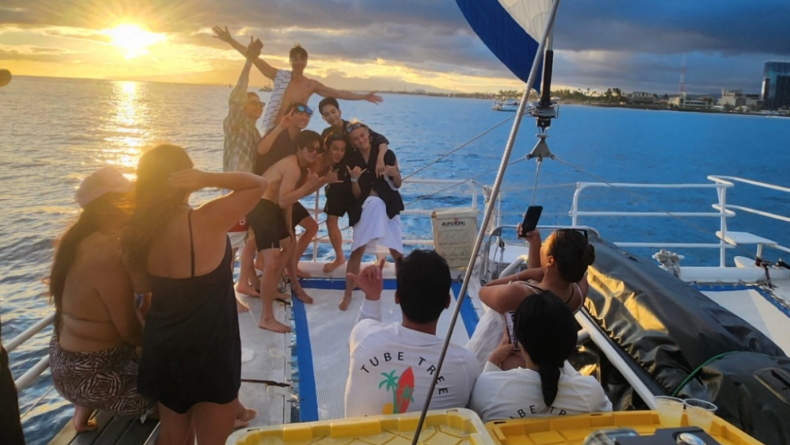
On a boat, once you leave the dock, there is nobody else. The nearest other human is a mile away, minimum. Any camera pointing at you is one you brought. Any conversation heard is one held by someone you invited. Any expectation applied to you was applied by you.
This is a structural quality of the experience. It isn't decoration. It isn't upgraded. It isn't premium. It's baked into the physics of being on a boat offshore. Which is why the same boat works equally well for a person who cannot walk through a mall unmolested and a person whose phone has forgotten how to stop buzzing. The physical structure of the experience solves both of their problems, from different directions, at the same time.
For more on why this experience feels different from any land-based version of "luxury," our piece on why privacy is the foundation of truly luxurious experiences gets deeper into the underlying philosophy.
The Detail That Surprises Everyone
Guests who have never chartered a private yacht before are almost always surprised by the same specific thing, and it is not what they expected to be surprised by.
They are not surprised by the boat, which is nice but looks the way boats look. They are not surprised by the captain, who is professional and friendly. They are not surprised by the food or the drinks or the towels or the music system, all of which are exactly what they expected.
They are surprised by the silence.
Specifically, they are surprised by the silence between the boat sounds. The engine hum, the water against the hulls, the wind, the occasional call from the captain — these are the sounds. Underneath them, there is nothing. No traffic. No overheard conversation. No refrigerator hum from the next room. No air conditioner cycling. No notification tone. No Uber driver's phone playing tinny music from the front seat.
Modern life has a background noise that most people have stopped noticing. On a boat offshore, that background noise vanishes. You didn't book the yacht for the silence, because you didn't know you were carrying the noise. But the silence is the first thing you notice, and it is the last thing you forget.
Our piece on what happens to you when land disappears goes deeper into this particular experience, the physiological, not just aesthetic, shift that happens when the shore stops being close.
Why the Same Boat Works for All Three
The K-Pop star boards the boat. He does not want to talk about being a K-Pop star. He wants to be a person for three hours. The crew, professionally, does not treat him differently than they treat any other guest. He is offered water. He is asked what music he'd prefer. He is left alone on the bow when he wants to be alone on the bow. He is 27 years old and this is the third time this year he has had a stretch of hours in which nobody has asked him to be famous.
The CEO boards the boat. His phone has one bar. He tries it once, mid-transit. It doesn't work. He puts the phone in his bag. It stays there. He is offered water. He is asked what music he'd prefer. He is left to sit with his wife on the aft deck without a single interruption for three hours. He is 47 years old and this is the first time in months he has watched a sunset all the way through without being pulled into a Slack thread halfway.
The couple boards the boat. They do not have a K-Pop star's fame or a CEO's phone burden. What they have is the accumulated weight of a decade of family logistics, work schedules, small worries, small compromises, small distractions. They are offered water. They are asked what music they'd prefer. They stand at the bow, together, for the first time in what feels like years, and they don't say anything for a long time.
The boat treats them the same way. The horizon treats them the same way. The three hours treat them the same way. Because the thing they are all paying for is the same thing. Which is: for a specific window of hours, not being anyone's anything except their own.
For more on this dynamic in practice, our piece on the quiet luxury of a private charter covers how this shows up across different guest types.
What Nobody Advertises
Charter brochures advertise the boat. They show the deck. They show the sunset. They show the champagne. They show a person laughing on the bow with wind in their hair.
None of them advertise what the guests actually buy. Because what the guests actually buy doesn't photograph well. You cannot take a picture of "unreachable." You cannot post an Instagram story of "for three hours my brain will not be scanned by anyone else." You cannot advertise "the specific quality of being unwatched" because the moment you advertise it, you are watching it.
So the product is sold in the language of the boat, and the guests understand because they are smart, because they are experienced, because they have already spent a decade paying for versions of privacy that didn't actually deliver privacy — that the boat is the metaphor. The boat is the vehicle for the actual thing. The actual thing is not photographable.
This is why the K-Pop star, the CEO, and the couple all book the same yacht. They are not confused about the product. They know exactly what they are buying. They are buying the thing that most people don't know they need until they've had it once. And once they've had it, they book again.
The Real Reason They Come Back
Every year, roughly a third of the private catamaran charters booked in Honolulu are repeat guests. Some of them are the same K-Pop star, back after another tour cycle. Some are the same CEO, back on the same Wednesday of the same August. Some are the same couple, celebrating a different anniversary.
They come back for the same reason they came the first time. The problem the boat solved once has not gone away. If anything, it has gotten worse. The K-Pop star is more famous now. The CEO has more devices, more responsibility, more people to be reachable to. The couple has more of the small accumulations of adult life that quietly separate them from each other during ordinary weeks.
The boat is the same boat. The three hours are the same three hours. The silence between the boat sounds is the same silence. And every year, it works.
For more on why this experience holds up across repeated visits, our piece on how slowing down creates truly luxurious moments covers the underlying dynamic.
What This Means for You
You may not be a K-Pop star. You may not be a tech CEO. You may not even be in that mid-40s couple's income bracket. None of that changes what a private yacht charter actually is or what it delivers. The mechanism is the same regardless of who you are.
You will board the boat. You will be offered water. You will be asked what music you'd prefer. You will leave the dock. The land will get smaller. Your phone will stop working reliably. The background noise you didn't know you were carrying will vanish. For three hours, you will be somewhere the world cannot reach, in the company of only the people you invited, being watched by exactly no one.
If that sounds like a small thing, it may be because you haven't had it in a while.
For more on what actually happens when you book, our guide on what actually happens when you book a private catamaran in Honolulu walks through it step by step. If you're new to the idea, our piece on what you're actually getting on a private charter covers the underlying value math.
Ready to set sail?
Book three hours the world can't reach. Your people, your boat, your horizon and none of the noise you brought with you.
📞 808-807-4800 · Island Jewel Yacht Charters
Related reading:
Why Privacy Is the Foundation of Truly Luxurious Experiences ·
What Happens to You When Land Disappears ·
The Quiet Luxury of a Private Charter