
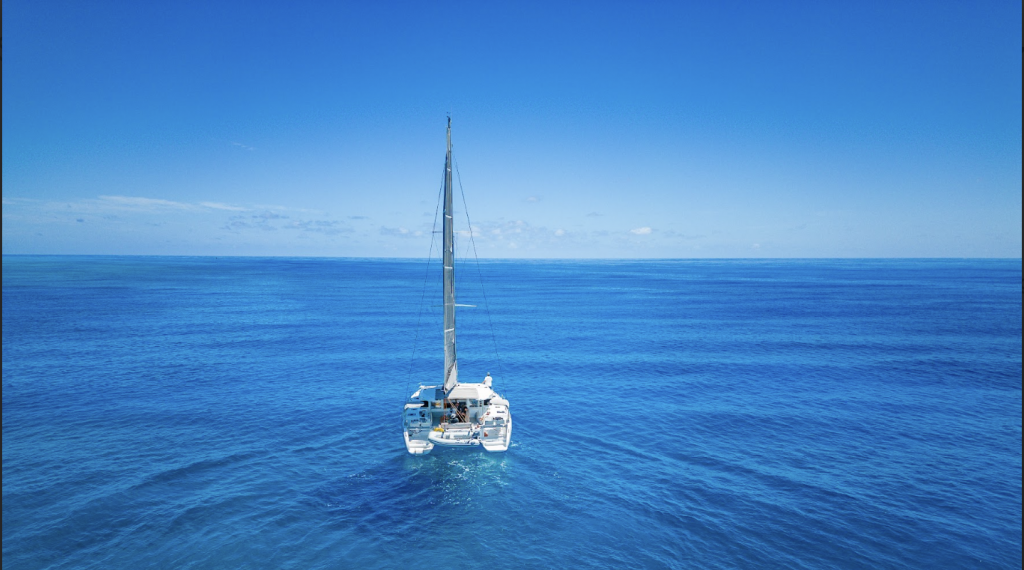
Most people have been on a boat before. A ferry, a tour vessel, maybe a whale watch out of some cold harbor somewhere. What they haven't been on is this.
The first thing you notice is that the boat doesn't tilt. You've braced yourself, instinctively, the way your body remembers every rocking vessel you've ever been on, and it just doesn't happen. The Island Jewel settles onto the Pacific with an almost uncanny calm, and you find yourself standing on the deck, fully upright, with a drink in your hand, watching Honolulu pull away from you like a painting slowly rolling up at the edges.
This is what a catamaran does that no other vessel can quite replicate. And understanding why — the actual physics of it, and the century of harbor history that brought a boat like this to Kewalo Basin — goes a long way toward explaining why a charter aboard the Island Jewel feels so different from anything you've done on the water before.
A Brief History of the Harbor You're Leaving From
Before you can understand the boat, it helps to understand the place it calls home.
Kewalo Basin Harbor has been a working relationship between the people of Honolulu and the sea for as long as there have been people here. The area was known to ancient Hawaiians as the fishery of Kukuluae'o — a productive and sacred stretch of shoreline that fed the community and served as a canoe landing long before any harbor infrastructure existed. The land belonged, at one point, to a chief named Ihu, a direct gift from Kamehameha I after the king's unification of the islands.
By the late 1800s, the harbor had taken on a different character. Japanese immigrants had introduced the sampan to Hawaii, a flat-bottomed wooden fishing vessel that became iconic on these waters — and the basin filled each morning with fleets of them, heading out before dawn to hunt aku and ahi using traditional live-bait, pole-and-line techniques. Stand at Kewalo Basin today and you're standing where those boats returned, loaded with skipjack and yellowfin tuna, for decades.
| HISTORICAL NOTE |
| Kewalo Basin: From Fishery to Charter Harbor |
| In 1913, the Victoria Ward family sold the land to the Territory of Hawai'i. The government began dredging operations in 1924, deepening the basin to accommodate commercial vessels. By 1926, when the lumber trade had faded, the harbor became home primarily to the commercial fishing fleet — the same water where the Island Jewel now departs every morning. |
| In the 1950s, eight acres of new land were created from dredged material along the seaward side of the harbor, forming what is now Kewalo Basin Park — the stretch of grass and coastline you see as you arrive for your charter. |
The harbor today is a working place, commercial fishing vessels, dive boats, charter vessels. There is nothing manicured or resort-like about it. That's worth something. When the Island Jewel clears the harbor mouth, it's leaving from the same water that Hawaiian fishermen have been navigating for centuries. The history doesn't make the water any bluer, but it makes it feel deeper.
Two Hulls. Everything Changes.
A catamaran is defined by its two parallel hulls — twin keels connected by a wide central deck called the bridgedeck. This is not a minor variation on the standard sailboat. It is a fundamentally different machine, with a different relationship to water, wind, and the people on board.
The single-hulled sailboat — the monohull — is one of the oldest and most elegant engineering solutions in human history. It works by using a heavy keel to counterbalance the force of the wind on its sails, which means it sails by heeling: tilting to one side under load, sometimes dramatically, sometimes enough to send the unprepared sliding across the deck. This is not a flaw. It's how the boat works. Sailors who love monohulls love this feeling — the lean, the spray, the physical conversation between boat and wind. The boat is a partner, always pushing back.
"A monohull sails by tilting. A catamaran sails by staying perfectly, almost defiantly, level — and using the sea's own energy to fly."
A catamaran operates differently. Without a heavy keel to counterbalance, it achieves stability through geometry: two hulls spread wide enough apart that the platform between them cannot easily tip. The beam — the width — of a well-designed catamaran is roughly half its length. The Island Jewel runs 40 feet long. Do the math. That's a platform nearly 20 feet wide. For comparison, most studio apartments are narrower.
The result is a boat that sails almost entirely upright. Not because the forces on it are weaker, but because the geometry defeats them. Wind fills the sails; the twin hulls bite the water and hold; the deck stays level while the ocean moves around it rather than through it.
| 40'
ISLAND JEWEL LENGTH |
~20'
BEAM WIDTH |
0°
TYPICAL HEEL ANGLE |
What This Feels Like When You're Standing on It
The abstract engineering becomes very concrete, very fast, once you're on the water.
On a monohull, there is always a high side and a low side. You unconsciously track them. You plant your feet wider. You hold the rail when you move. You don't put your drink down without thinking about it first. None of this is unpleasant — it's part of the experience — but it occupies a quiet background process in your body the entire time you're sailing.
On the Island Jewel, that process stops. You walk across the deck. You sit on the bow with your feet dangling over the Pacific. You pour a drink. You stand at the very front of the boat with nothing around you but ocean and sky and the distant amber profile of Diamond Head, and you don't hold anything — because you don't need to. On a sunset sail, this is when the light goes gold and the city skyline turns into something out of a dream.
| The stability also changes something in guests that is harder to quantify. The absence of the low-grade physical vigilance that comes with a rocking, heeling vessel allows the nervous system to relax in a way that doesn't happen on other boats. It's one of the reasons catamaran charters are consistently described by guests not just as beautiful, but as genuinely RESTORATIVE. |
The wide platform means the space onboard is expansive in a way that most boats aren't. The cockpit of the Island Jewel can seat your entire group comfortably. The bow has room to spread out, lie down, watch the water. The full-service kitchen is below, accessible without gymnastics. The catamaran is, in practical terms, a floating living room that happens to be moving across the Pacific at 7 knots. See all charter options to find the right duration for your group.
The Seasickness Question
It comes up in almost every booking conversation, and it deserves a direct answer. (It's also one of the most common questions in our FAQ.)
Seasickness is caused by the conflict between what your eyes see (a stable environment) and what your inner ear feels (motion). The more violent the motion — the more unpredictable the rolling and pitching — the worse it gets. A monohull in choppy water can combine heeling, pitching, and rolling simultaneously. The inner ear logs all three axes of movement and the brain, confused, responds with nausea.
A catamaran eliminates the heeling entirely. It reduces rolling significantly. What remains is primarily the fore-and-aft pitching — the nodding motion as the bows push through swells — and even this is softened on a well-designed, wide-beamed vessel like the Island Jewel by the distribution of weight across two hulls rather than one.
The waters off Honolulu's south shore, sheltered from the North Pacific swells that batter the island's north coast, are among the calmest sailing waters in Hawaii. Charter guests who arrive convinced they'll be sick almost universally report feeling fine — often surprisingly so. The boat itself does most of the work.
One More Thing About Catamarans and the Pacific
There is a footnote to this story that belongs here.
The catamaran is not a modern invention. The twin-hull design originated with the Austronesian peoples — the ancestors of today's Polynesians — thousands of years before European sailors had ventured out of sight of land. The ancient Hawaiian double-hulled voyaging canoe, the wa'a kaulua, was a catamaran. The Polynesian wayfinders who first reached these islands, navigating 2,400 miles of open Pacific by stars and swells and the behavior of birds, arrived on vessels built on the same fundamental principle as the boat you're boarding at Kewalo Basin: two hulls, wide beam, stable platform, capable of crossing the world's largest ocean.
When you stand on the bridgedeck of the Island Jewel and feel it hold steady as the trade winds fill the sails and Diamond Head grows small behind you, you are sailing on a design that has been crossing these waters for longer than written history can reach. On a Friday evening, that same deck is where guests watch the Hilton Hawaiian Village fireworks light up the sky over Waikiki — ancient water, modern wonder. The engineering is different. The materials are different. The purpose is entirely different.
But the principle — twin hulls, spread wide, holding the sea at a respectful distance while you move across it — is the same one that first brought people to these islands.
That seems worth knowing.
Island Jewel departs from Kewalo Basin Harbor, 1025 Ala Moana Blvd, Honolulu. Book at 808-807-4800