
The ocean off O'ahu has a way of resetting something deep inside you. Here's why.
There is a specific moment — it happens differently for every person, but it always happens — somewhere between leaving Kewalo Basin and losing sight of the concrete edge of the world. The buildings of Honolulu begin to compress into a thin gold stripe on the horizon. The traffic fades first, then the sirens, then even the sound of your own thoughts. The sails fill. The hull lifts. And something in you goes quiet that you didn't even know was loud.
It isn't relaxation exactly, though it feels like that. It's closer to recognition — as if your body has returned to a state it was always meant to be in, and simply forgot.
The Wind Before You Have Words for It
The first thing you feel out here is the trade wind. It arrives from the northeast, steady and cool, the same wind that ancient Polynesian navigators read like a language — tilting into it, feeling its pressure shift against their cheeks to know if their course had drifted in the night. These winds blow more than 250 days a year across the waters south of O'ahu. They are among the most reliable winds on earth.
Out here, that reliability becomes something personal. The wind pushes your hair back and dries the salt on your lips. It fills the sails with a sound like held breath releasing. You stop thinking about where you were supposed to be an hour ago. You stop reaching for your phone. The wind, without asking, has your full attention.
Lē'ahi, Shrinking
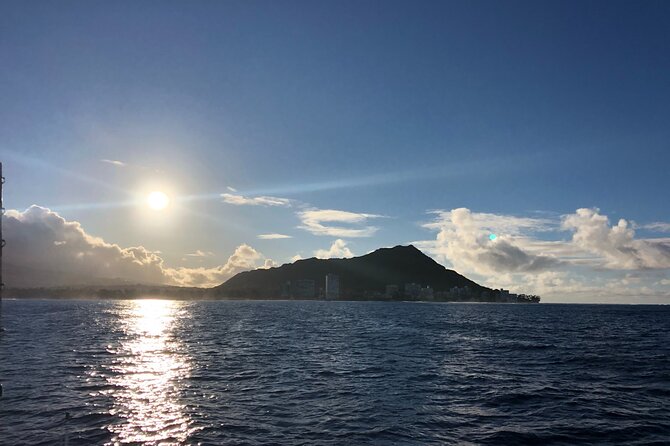
If you look back toward shore as the catamaran moves south, you'll see it: the silhouette of Lē'ahi — what the world knows as Diamond Head. That flat-topped volcanic crater, formed roughly 300,000 years ago in a single eruption of fire and steam, now sits against the sky like a sleeping giant. From the water, it looks exactly like what ancient Hawaiians named it: lae (brow) and ʻahi (tuna fish) — the broad, curved forehead of a great fish rising from the sea.
For centuries, this ridge served as a navigational beacon. Hawaiian voyagers read its profile from miles offshore to know where home was. British sailors in the 1800s mistook volcanic calcite crystals on its slopes for diamonds and gave it a name that stuck. And now, from the deck of the Island Jewel, it shrinks behind you — slowly, steadily — until it becomes just a shape at the edge of the sky. A marker that says: the land is still there. But you are no longer on it.
This is the moment.
What the Hawaiians Always Knew: Kai
The Hawaiian word kai means ocean. But it never meant only that. In Hawaiian culture, kai was a sacred force — the source of life, the road between worlds, the domain of Kanaloa, god of the sea and of healing. Before entering the water, Hawaiians would offer pule, prayer. Hālau hula dancers would immerse themselves before a major performance to cleanse their spirit and quiet the mind. Ocean water — the kai itself — was understood to carry the memory of those who had crossed its surface before, to connect the living to their ancestors, to heal what had gone silent inside a person.
This is not metaphor. Or rather — it is metaphor the way all deep truths become metaphor, which is to say, it points to something real. Every ripple you cross was crossed before you. In the deepest sense, the water beneath this hull has connected generations of people to something larger than themselves.
Mālama i ke kai — care for the sea — was not just an environmental ethic. It was the recognition that the sea takes care of you in return.
The Science Has a Name for It
Marine biologist Dr. Wallace J. Nichols spent decades studying what happens to the human brain near water. He called it "blue mind" — a mildly meditative state that water reliably induces, marked by lower stress hormones, slower heart rate, reduced anxiety, and heightened creativity. Bodies of water exist in a state of simultaneous consistency and change — moving, always moving, but never threatening. The brain reads this as safe. The vigilance loosens. The relentless background noise of modern life — notifications, obligations, the low hum of ambient worry — falls away.
You don't have to understand the neuroscience to feel it. You just have to go.
The salt air, the rhythmic lift and settle of the hull, the horizon — that one clean, uninterrupted line where blue meets blue — these are not incidental pleasures. They are physical acts of restoration.
Our Ancestors Crossed This Ocean
The Polynesian navigators who first reached Hawaiʻi sailed double-hulled canoes across thousands of miles of open Pacific without charts, compass, or instruments. They navigated by starlight and the behavior of seabirds, by the temperature of current beneath their palms, by the feel of wave patterns through the hull. The master navigator Mau Piailug could close his eyes on a rolling sea and distinguish five separate ocean swells pressing against the boat — each one a message about direction, distance, where land was waiting beyond the horizon.
This knowledge was passed down through generations in song and story and physical memory. And then, for a time, it was nearly lost. In 1976, the voyaging canoe Hōkūleʻa — named for Arcturus, the star directly overhead at Hawaiʻi's latitude — sailed from Honolulu to Tahiti using only traditional wayfinding. When it arrived, more than ten thousand people gathered on the shore. The ocean had carried its people home.
Something about being on open water off this coastline connects you to that inheritance — whether you know it or not. You are not just a visitor on a boat. You are a human being on an ancient highway.
The Return
When the Island Jewel turns back toward Kewalo Basin, Honolulu re-emerges from the horizon the same slow way it disappeared. The buildings appear first, then the sound of the city, then the heat rising off the pavement. By the time you step onto the dock, something has shifted. A clarity that wasn't there before. A slowness in the chest. A quiet that lingers longer than it has any right to.
This is what the water gives. Not escape, exactly. More like return — to something quieter, slower, older inside yourself. The ocean has been doing this for every person who has ever floated on it. The Hawaiians understood. The wayfinders knew.
And out beyond Diamond Head, the kai is waiting to remind you too.
Ready to feel it for yourself? Book your charter at islandjewelyachtcharters.com or call (808) 807-4800.