
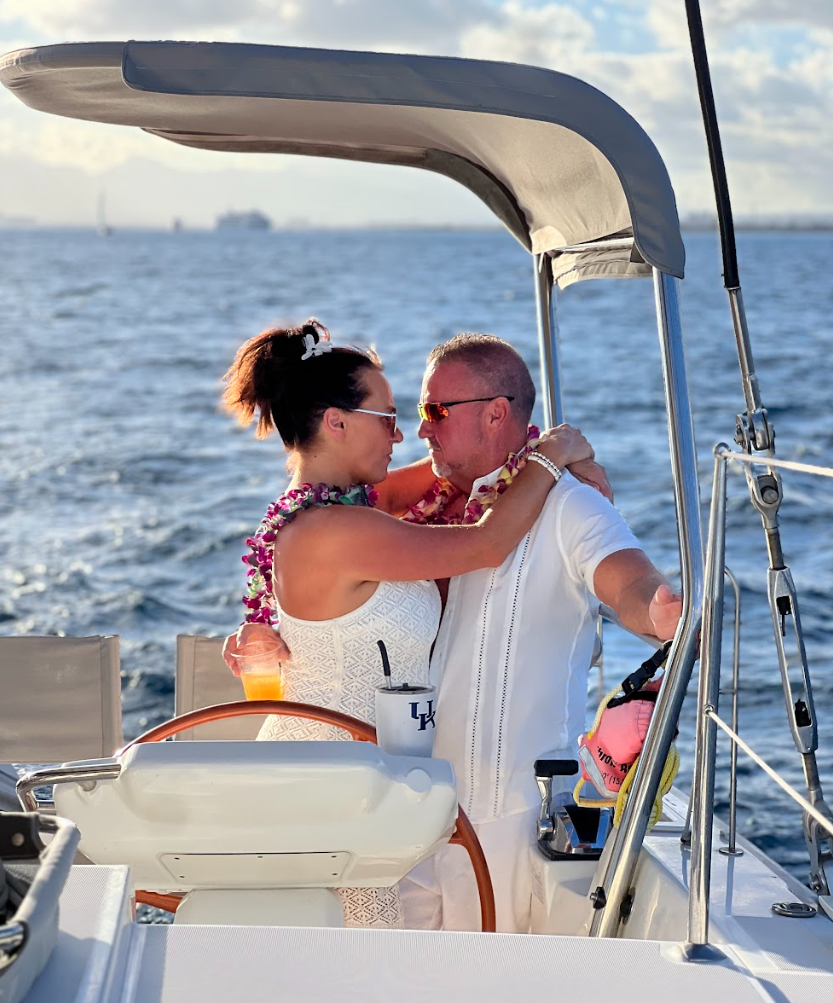
Ten years from now, you will not remember what your uncle said in his toast. You will not remember the exact temperature of the champagne. You will not remember the song that was playing when you cut the cake. What you will remember is roughly six photographs. The one where your grandmother is dabbing her eye. The one where your partner is looking at you and you didn't know they were being photographed. The one on the bow, sunset behind, with the whole wedding party. The one where you both are laughing at something nobody remembers now. The candid at hour four. And the printed portrait that ends up above your fireplace.
Those six photographs will do most of the emotional work of remembering your wedding for the rest of your life. Everything else about the day will soften into a general warm feeling. The photographs will stay crisp.
This matters more than most couples realize when they're planning a yacht wedding in Oahu. The venue is one of the most photogenic in the world. The light is arguably the best on any wedding day, anywhere. But the specific conditions of shooting on a moving boat, at golden hour, in Hawaiian conditions, are different enough from a land wedding that generic wedding photography advice actively hurts your outcome. The best yacht wedding photographers know these differences. Most photographers do not.
This is the complete guide to getting the wedding photography on your Oahu catamaran right. What to plan, what to skip, what to insist on, and what the photographer needs to know before the boat leaves the dock.
|
87%
Couples hire a photographer
|
$4-8K
Destination photographer range
|
45 min
Golden hour window in Hawaii
|
10-15%
Of wedding budget on photos
|
87% of couples hire a professional wedding photographer, with the average American couple spending around $2,900. For destination weddings, the range typically climbs to $4,000 to $8,000 given travel, location expertise, and extended coverage (The Knot Real Weddings Study, 2025). For a yacht wedding specifically, expect the upper end of that range, and know that experienced yacht photographers are worth the premium.
Why Yacht Photography Is Different (And Why It Matters Who You Hire)
A yacht wedding in Oahu presents four photography challenges that don't exist at a land venue.
First, the boat is moving. Even a stable catamaran has gentle motion that makes long exposures difficult and camera-shake more common. Sharp handheld shots require faster shutter speeds than a photographer would use in a hotel ballroom.
Second, the light changes fast. Golden hour in Hawaii lasts roughly 45 minutes, and inside that window the light shifts every 5 minutes. A photographer used to shooting land weddings will often be caught adjusting settings when the light has already moved on to the next phase. Experienced yacht photographers pre-plan for each light phase.
Third, the space is compressed. There is no separate ceremony area, cocktail area, and reception area with different sight lines. Everything happens in the same 40 to 55 feet of deck. This means the photographer needs to plan angles and positions before the ceremony, not adjust in real time.
Fourth, salt air and equipment don't mix. Professional yacht photographers bring weather-sealed bodies, backup gear, and cleaning cloths. Amateur photographers occasionally show up with equipment that will need major service after a single Hawaiian charter, and their shooting suffers because they're worried about their gear.
The upside of these challenges: photographers who have mastered them produce some of the most striking wedding photography in the world. Once-in-a-decade light. Zero background clutter. Diamond Head glowing behind the couple. Water reflecting the sky. There is no better wedding photography setting in Hawaii, if you have the right person behind the camera.
For the broader wedding planning context, our complete Oahu catamaran wedding planning guide covers everything else you need to know outside of photography specifically.
The Six Photographs That Define the Day
Every yacht wedding produces roughly 300 to 600 photos. Six of them will end up framed, printed, sent to grandparents, made into Christmas cards, hung above the fireplace. Every couple ends up with roughly the same six categories of "the ones that mattered." Knowing this in advance changes how you brief your photographer.
Every one of these six shots is planned, not lucky. A great photographer knows which moment produces each shot and positions themselves accordingly. A mediocre photographer captures three of the six. A poor photographer gets one, and it's often out of focus.
Timing the Ceremony Around the Light
This is the single most important decision you'll make about your wedding photography. Get this right and every other decision becomes easier. Get it wrong and no amount of post-processing will save the day.
Hawaii's golden hour is legendary but brief. It lasts roughly 45 minutes, starting about 60 minutes before sunset. Within that window, the light shifts through four distinct phases:
- Warm Gold (60 to 40 minutes before sunset): Light is warm, directional, still bright enough for group photos without needing flash. This is the best window for the family and wedding party group shots.
- Sweet Gold (40 to 20 minutes before sunset): Peak romantic light. The sun is low, backlight is strong, portraits glow. This is when the couple's portraits happen.
- Deep Gold (20 to 5 minutes before sunset): Light is dropping fast. Sun is on the horizon. This is the window for the kiss shot and the ceremony peak moments.
- Pink Hour (5 minutes before to 20 minutes after sunset): The sky lights up with pink, purple, and orange. Great for silhouette shots but the light is too low for detail work.
For a yacht wedding, the recommended sequence is:
- Boarding and cocktails: 90 to 60 minutes before sunset
- Ceremony start: 45 minutes before sunset
- Vows and ring exchange: 30 minutes before sunset (Sweet Gold light)
- The kiss: 15 minutes before sunset (Deep Gold, sun near horizon)
- Recessional and toast: Sunset moment
- Group photos: Immediately after ceremony, still in golden light
- Reception and dancing: Post-sunset, into pink hour
Book the boat departure 2.5 hours before sunset. That gives you 30 minutes for boarding logistics, 15 minutes for pre-ceremony photos of the couple separately, then a full ceremony arc timed exactly to the light.
Our guide to when to book covers month-by-month sunset times, which shift by roughly 90 minutes between summer and winter and require adjusting your entire schedule accordingly.
The Bow Portrait (The Photograph That Ends Up Framed)
Almost every couple who marries on a Hawaiian catamaran ends up with the same shot as their framed wedding portrait: the bow of the boat, sunset behind, the two of them looking at each other or into the camera. This shot is not accidental. It is the most-planned photograph of the entire day, and it deserves its own dedicated 15-minute slot.
The setup:
- Boat positioned so the sun is directly behind the couple (or slightly to the side to avoid pure silhouette)
- Diamond Head or open ocean in the background depending on the boat's position
- Couple standing at the very tip of the bow, close together
- Photographer positioned aft, shooting into the bow with the sun behind subjects
- Camera settings pre-configured for backlit portraits (fast shutter, wide aperture, careful metering off skin)
The shot happens twice: once at Sweet Gold light (40 to 20 minutes before sunset) for the "clear light on faces" version, and once at Deep Gold (10 minutes before sunset) for the "sun on horizon" dramatic version. You'll want both. One usually becomes the framed print. The other usually becomes the album cover.
Give your photographer 15 minutes of protected time for this. No family members hovering. No coordination happening. Just the couple, the bow, and the light.
The Family Group Photograph (Do This Right or Regret It)
The multi-generation family group photo is the shot grandparents will send to everyone they know. It is often the last group photo taken of certain family members before they pass. This is not overstating it. For couples marrying in their 30s and 40s, the family photo from the wedding often becomes the last complete family portrait that includes older relatives.
The rules:
- Take it early, in Warm Gold light (60 to 45 minutes before sunset). If you wait until after the ceremony to do family photos, the light has moved on and you'll lose the shot to darkness or need flash.
- Have a designated shot list ready. The photographer needs to know exactly which family combinations to shoot: couple with bride's parents, couple with groom's parents, couple with all grandparents, couple with siblings only, couple with all family, etc. Print this list, hand it to the photographer or a designated coordinator, and don't wing it.
- Coordinate outfits in advance. Send a family group text one month before: "For the family photo we're getting on the boat, please dress in the cream, white, tan, or sage family. It photographs beautifully together." Not matching outfits, just coordinated temperature.
- Take it on the bow, not the aft deck. Better backdrop, more space, better light.
- Get it done in 15 minutes maximum. Family members lose patience fast. Have the shot list, execute quickly, move on.
For more on how multi-generational family dynamics work on a catamaran, our multi-generational family reunion guide covers the broader dynamic beyond just weddings.
Drone Photography (The Rules Nobody Tells You)
Aerial shots of the catamaran with the couple on the bow, Diamond Head in the frame, wake behind the boat, are among the most-requested wedding photography shots in Hawaii. They are also legally complicated in ways most couples don't realize.
Federal FAA rules apply to every drone flight:
- Commercial drone operators (any photographer being paid) must hold a Part 107 remote pilot certificate
- The drone must be registered with the FAA
- Line of sight must be maintained at all times
- Maximum altitude is 400 feet above ground level
- Flying over people who aren't part of the flight operation requires additional certifications
Hawaii-specific rules also apply:
- Honolulu and offshore Waikiki areas are near class B airspace requiring FAA authorization
- Certain marine sanctuaries prohibit drones entirely
- Wildlife (especially Hawaiian monk seals and spinner dolphins) cannot be disturbed
What this means practically:
- Hire a Hawaii-based licensed drone operator. Do not assume your mainland wedding photographer can fly drones here legally.
- Confirm they hold Part 107 certification and file necessary FAA airspace authorizations in advance
- Budget for this as a separate line item, typically $500 to $1,500 in addition to your main photographer
- Expect roughly 15 to 20 minutes of actual flight time during the charter
- The drone shots happen at Sweet Gold light for best results, timed with the couple's bow portrait
If drone shots matter to you, plan for them explicitly. If they don't, don't feel obligated. Some of the most beautiful yacht wedding photography is entirely from-the-deck, and drone shots can feel gimmicky if they're the focus rather than a complement.
Choosing Your Yacht Wedding Photographer
Not every wedding photographer can shoot a yacht wedding well. The specific skill sets that separate great from disappointing:
Look for photographers who:
- Have shot 10+ yacht weddings before (ask for portfolios specific to boat weddings)
- Are Hawaii-based or spend significant time shooting in Hawaii
- Use weather-sealed camera bodies (Canon R5, Sony A7 IV, Nikon Z9, or similar)
- Bring backup camera bodies and lenses
- Have experience with fast-changing light conditions
- Have delivered wedding galleries you can review from Hawaii venues
- Include an assistant or second shooter (essential for yacht weddings)
Avoid photographers who:
- Say "yes we can figure it out" when asked about boat-specific experience (translation: no, they can't)
- Only show land wedding portfolios
- Shoot alone with no second shooter
- Push for a full-day 10+ hour package (yacht weddings are 4 to 6 hour events)
- Don't mention drone options at all (they either don't have licensing or don't know the market)
- Charge dramatically below market rate ($1,500 or less for destination coverage is a warning sign)
Budget realistically. For yacht wedding photography in Oahu, expect $4,000 to $8,000 for a strong professional. Higher end ($8,000 to $15,000) buys you top-tier photographers with high-end publication credits. The mid-tier of $4,000 to $6,000 delivers outstanding results for the vast majority of yacht weddings.
For general wedding planning context, our Oahu catamaran wedding planning guide has broader coverage of budget planning.
The Pre-Charter Photographer Briefing
The 30-minute conversation you have with your photographer 48 hours before the wedding is the single most important pre-wedding preparation you'll do. If your photographer doesn't offer this briefing, insist on it.
Cover these topics:
- Exact sunset time for your wedding date. Confirm to the minute.
- Ceremony start time and duration. How many minutes for vows, ring exchange, kiss.
- The must-capture shot list. Print the list of specific family groupings and moments you want documented.
- Coordinated outfit palette. Confirm what the family and wedding party are wearing.
- Special moments the photographer wouldn't know about. Grandmother's meaningful gift. Ring inscription. First dance song backstory.
- Boat layout and positioning. Where the ceremony will be set up, where guests will be seated, where the cake and toast will happen.
- Weather contingency. If afternoon showers move in, what's the plan?
- Timing of the drone shots if you have a drone operator.
- How photos will be delivered. Timeline, format, sneak peek expectations.
This briefing is what separates weddings where the photographer captures every important moment from weddings where important moments are missed because the photographer didn't know they were coming.
What to Wear for Yacht Wedding Photography
The wardrobe decisions for a yacht wedding are photography decisions. What you wear either enhances or limits the photos you'll have for the rest of your life.
For the couple:
- Bride: Tea-length or knee-length dress works better than full-length gown on a boat (wind, movement, boarding). Halter or straight-across neckline photographs better than strapless (wind risk). White or ivory always. Delicate jewelry, not statement pieces.
- Groom: Linen suit in white, tan, or navy. Open collar. Boat shoes or leather slip-ons (never dress shoes on a yacht).
- Both: Barefoot for the ceremony is beautiful and expected. Sandals for boarding and post-ceremony.
For the wedding party:
- Coordinated tones in the cream, blush, sage, or Hawaiian floral family
- Not all identical outfits (looks staged)
- Fabrics that move in wind (chiffon, silk, jersey)
- Flat sandals for everyone
For guests:
- Elevated resort attire (sundresses, linen shirts, jumpsuits)
- Send a note requesting the color palette a month ahead
- No heels, ever (safety issue and boat rule)
- Bright colors work well against blue water
Our complete yacht style guide by season covers dress code in more detail across every yacht occasion, and the specific reasons certain fabrics and colors photograph well on the water.
The Second Shooter Question
A second photographer at a yacht wedding costs an additional $500 to $1,500 typically. For most yacht weddings, this is worth it, sometimes essential. Here's why.
A single photographer cannot be in two places at once, and yacht weddings have simultaneous critical moments. The kiss happens while the family is still gathering for the group shot. The bride's reaction to seeing the groom happens at the same moment the groom is walking down the aisle. The couple's toast happens while guests are receiving cocktails from the crew.
With a second shooter:
- Primary photographer covers the couple; second shooter covers guests' reactions
- Primary covers the ceremony from the front; second covers from behind
- Primary handles the bow portrait; second captures the guests watching from the deck
- Primary handles the toast from the couple's angle; second captures the toaster
For weddings of 20 guests or fewer, a single photographer can typically handle it. For 25 to 49 guests, a second shooter is highly recommended. Your photographer will suggest this if you don't ask, but it's worth understanding why they're recommending it.
Delivery, Editing, and What "Wedding Photography" Actually Includes
Different photographers include different things in their base package. Confirm all of the following in writing before booking:
- Number of edited high-resolution digital images: Standard is 300 to 500 for a 4-hour yacht wedding. If you're being offered 100, that's low. If you're being offered 1000, that's likely unedited.
- Turnaround time: Sneak peek within 48 hours, full gallery within 4 to 8 weeks. Some photographers push this to 12 weeks. Confirm in writing.
- Editing style: Do you like their editing? Look at recent galleries. Some photographers over-process, some under-process. Neither works for a wedding.
- Print rights: Do you have the right to print your own photos, or are you locked into their print service?
- Raw file access: Standard is no (photographers protect their editing IP). Sometimes negotiable for a fee.
- Album inclusion: Does the package include a wedding album? Or is it available as an add-on?
- Travel and accommodation: For destination photographers, who pays travel expenses?
The Guest Photography Consideration
Guests at a wedding always take photos. On a yacht, this can create a photography problem: guests standing in the way of your paid photographer, guests holding up phones during the vows, guests posting Instagram Reels that leak before your paid photographer's gallery goes live.
The gentle solution:
- Include an "unplugged ceremony" note in your wedding program or a small sign near the ceremony area
- Ask the officiant to say a brief line at the ceremony start about being fully present and putting phones away for the vows and kiss
- Designate one person to be the "phone photo taker" for group shots so guests don't crowd your professional photographer
- Encourage phone photos during the reception and post-sunset when the professional photographer is capturing wide shots and candids anyway
- Set expectations about social media posting. Some couples ask guests to wait until after the couple posts first. Some are fine with immediate posting. Communicate your preference clearly.
Backup Plans and Weather Contingency
Weather in Honolulu is remarkably stable, but Hawaii can produce quick afternoon showers, especially in winter. Your photography plan needs a rain plan.
If light rain moves in during the ceremony:
- The ceremony continues. Most yacht ceremonies happen under partial cover; light rain is manageable.
- The photographer switches to weather-sealed gear and continues shooting.
- The couple often uses clear umbrellas as a photography prop (some of the most striking wedding photos in Hawaii include rain).
If heavy rain moves in:
- The captain assesses conditions. If safe, the charter continues.
- If not safe, the charter is postponed. You may reschedule.
- Your photographer's rebooking policy needs to be confirmed in advance.
The always-there backup: Hawaii afternoon showers typically last 10 to 30 minutes and pass through. If the sunset window is genuinely at risk, the captain will often adjust the boat's position to stay in clear weather. Trust the captain and photographer's judgment on this.
For the broader question of what happens if weather disrupts your charter, our complete guide to what actually happens when you book covers cancellation and weather policies.
The Photograph You'll Print the Biggest
There is one photograph, from every yacht wedding, that ends up printed larger than any other. Usually 24 by 36 inches or larger. It goes above the mantle, in the entryway, or in the master bedroom. It is not always the shot you'd expect.
Sometimes it's the bow portrait. More often, it's a candid: the two of you laughing, an unstaged moment, backlit by sunset, the sky doing something photographers spend years trying to catch. It might be the shot of you looking at your partner during the vows, mid-sentence, unaware of the camera. It might be the walk down the aisle, guests blurred, focus on your face.
The best yacht photographers spend more time hunting for these unpredictable candids than they do setting up posed shots. They know the posed shots are safe. The candids are the ones that become the framed piece. Ask your photographer directly: "How much of your time will be spent on posed shots versus candid moments?" The right answer is roughly 40% posed, 60% candid. Photographers who quote 80% posed and 20% candid tend to miss the shots that actually last.
For the underlying philosophy of what makes a private yacht experience different from any other Hawaii activity, our piece on the quiet luxury of a private charter covers it, and much of that translates directly to why yacht wedding photography lands so differently from land wedding photography.
Ready to Capture the Photos That Will Last
Ten years from now, six photographs from your Oahu yacht wedding will do most of the work of remembering the day. Which photographs, and how good they are, is determined right now, by the planning decisions you make in the months before the wedding.
Hire the right photographer. Time the ceremony to the sunset. Plan the family group shot early, in Warm Gold light. Coordinate the wardrobe palette. Book a second shooter for weddings over 25 guests. Have the 48-hour pre-charter briefing. Trust the professionals on the boat and the crew.
Do all of that and you'll end up with the six photographs that define your marriage for the rest of your life. Skip any of it and you might get four out of six, or two, or one. The difference between a wedding you remember through photographs and a wedding you remember through vague warm feelings is planning.
For the broader wedding planning, our complete Oahu catamaran wedding planning guide covers everything else, from permits to cake logistics to the multi-generational family dynamics.
Ready to set sail?
Let's plan the wedding charter that becomes the photographs on your wall for the next 30 years. Weekend sunset slots for weddings book 4 to 6 months ahead.
📞 808-807-4800 · Island Jewel Yacht Charters
Related reading:
Wedding on a Private Catamaran in Oahu, Complete Planning Guide ·
What to Wear on a Luxury Yacht Charter in Hawaii ·
How to Plan the Perfect Proposal on a Private Yacht in Oahu